
How to Reschedule Dental Patients Fast When a Typhoon Hits
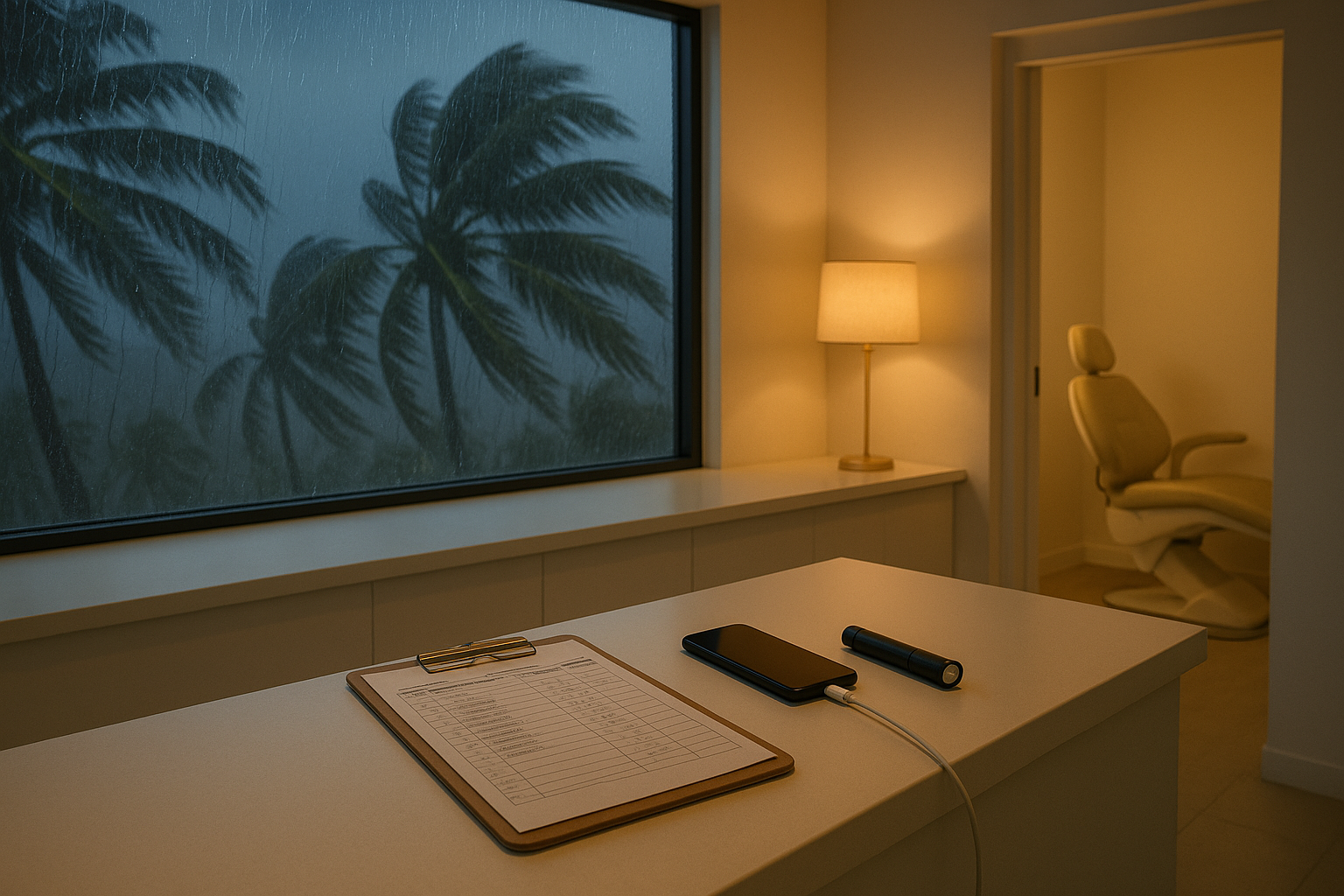
It's 5:20 on a Wednesday afternoon. PAGASA's 5 PM bulletin has just put Cebu under Signal No. 2, and tomorrow you have twelve patients booked, starting with a 9 AM cleaning. Jen, at the front desk, asks what everyone in the clinic is thinking. "Doc, sarado ba tayo bukas?"
Where those twelve patients end up next week depends mostly on the next three hours. And those three hours are a lot easier if you made the big decision months ago.
The short version
- Decide by a fixed time the evening before, using a closing rule you wrote at the start of the season.
- Print tomorrow's list and have the dentist mark who can't wait.
- Post the closure once, then contact every booked patient directly that same evening, while the power and the signal are still up.
- Rebook the urgent patients first. Spread everyone else over the next week or two, and keep a slot or two empty on the first day back.
- Three days after you reopen, chase anyone who still doesn't have a date.
Decide before the season, not at 5 PM
If you make this call on the day, you make it late and tired, with staff in the group chat asking whether they should come in. Make it once instead, calmly, while the weather's fine.
You'll need it more than once. PAGASA counts an average of 20 tropical cyclones in the Philippine Area of Responsibility each year, with about eight or nine crossing the country, and the peak runs from July to October (PAGASA). Not all of them reach your city, but enough do that deciding from scratch each time means deciding differently each time, and your patients and staff never know what to expect.
Pok Oi Hospital's dental clinics in Hong Kong take the decision out of the day. They publish a one-page table: if Typhoon Signal No. 8 goes up before 9 AM, the clinic is closed, appointments in the affected hours are cancelled, and patients call to rebook once service resumes (Pok Oi Hospital). Nobody at the front desk decides anything on the day, and patients already know what happens. We'd change one thing for a Philippine clinic: don't wait for patients to call you back. Give them a new slot. The texts further down do exactly that.
Here, the obvious trigger is PAGASA's wind signal. Every tropical cyclone bulletin prints a warning lead time under each signal, and the lead time is what makes a rule work.
| Signal | Winds | Warning lead time | Threat to life and property |
|---|---|---|---|
| No. 1 | 39 to 61 km/h | 36 hours | Minimal to minor |
| No. 2 | 62 to 88 km/h | 24 hours | Minor to moderate |
| No. 3 | 89 to 117 km/h | 18 hours | Moderate to significant |
| No. 4 | 118 to 184 km/h | 12 hours | Significant to severe |
| No. 5 | 185 km/h or more | 12 hours | Extreme |
The figures are PAGASA's, as summarised on Wikipedia's Tropical Cyclone Wind Signals page.
Signal No. 2 at the 5 PM bulletin means gale-force winds could reach your area within 24 hours. That covers all of tomorrow's clinic hours. That's why a rule like this one is a good place to start:
If PAGASA's 5 PM bulletin puts our city under Signal No. 2 or higher, we're closed tomorrow. If the signal goes up overnight, we decide after the 5 AM bulletin and text everyone by 6:30.
Set your own threshold. A clinic in a part of Manila that floods easily may add "or a red rainfall warning for our area", because a flooded road closes you just as well as wind does, signal or no signal. A clinic where most of the staff commute in from the next town may close at Signal No. 1.
Once it's written, post it on your Facebook page and pin it. Then when the 5 PM bulletin lands, Jen can answer every "sarado po ba kayo?" with the pinned post instead of a guess.
Don't wait for "walang pasok"
It's tempting to wait for the class suspension. That announcement covers schools, and government offices when Malacañang or the LGU says so. It doesn't close a private clinic, and it doesn't always come early enough for patients who are already planning their morning.
For a private business, the decision is yours. DOLE's Labor Advisory No. 14, series of 2026, lets private employers suspend work during typhoons and heavy rain to protect their staff, and says workers who can't report because of the weather shouldn't face sanctions for it (PhilSTAR Life). Nobody should have to ride a jeepney through floodwater to open the clinic.
The evening plan, hour by hour
Here's what the three hours after the 5 PM bulletin look like when your rule says close.
| Time | What happens | Who |
|---|---|---|
| 5:00 to 5:30 | Read the bulletin, apply the rule, tell the team | Owner |
| 5:30 to 6:00 | Print tomorrow's list with phone numbers. The dentist marks who can't wait | Front desk and dentist |
| 6:00 to 6:15 | Post on Facebook, set Google special hours, change the Page's automatic reply, block tomorrow in your booking system | Front desk |
| 6:15 to 8:00 | Call the urgent patients first, then text everyone else one by one. Move each booking as you go | Front desk |
| 8:00 | Try again for anyone you didn't reach, and note it on the list | Front desk |
Why the evening, and not first thing tomorrow?
Power, for one. When Kristine hit Bicol in October 2024, the National Telecommunications Commission said the main cause of the telco outages was commercial power interruptions (GMA News). Cell sites need electricity. The evening before the storm arrives, your signal is far more likely to be up than the morning after.
Then there's the patient. A text at 6:30 in the evening reaches someone who hasn't made plans yet. A text at 6:30 in the morning reaches someone who has already booked a ride, asked for a half-day off, or left the kids with Lola.
And there's your staff. A morning decision means someone has to be awake before six sending a dozen texts, and it's usually the same person you've just told to stay home.
Print the list, even if you never print anything else. If the power goes, a booking system you can't open won't help you call anyone. While you're at it, charge the clinic phone and a power bank.
Cut the "open po kayo?" messages before they start
- Pin one Facebook post that says what happens to people's appointments, so they don't all message you to ask. The template is below.
- In your Google Business Profile, add tomorrow under Special hours and mark it closed, so Google Maps doesn't tell people you're open (Google Business Profile Help).
- Swap your Page's automatic Messenger reply for a closure message for the day.
Sort the list before you send a single text
Not all twelve patients are the same problem. Before Jen picks up the phone, the dentist spends two minutes with the printed list and marks every name A, B or C.
| Group | Who's in it | Rebook | Contact |
|---|---|---|---|
| A: can't wait | Whoever the dentist marks. For example: post-extraction checks, stitches due out, a root canal mid-treatment, anyone booked for pain or swelling | First day back, in slots you hold empty | Phone call, tonight |
| B: has a deadline | Braces adjustments, HMO approvals with an expiry date, patients about to leave town or fly abroad | Before the deadline | Text tonight, then a call once you reopen to confirm |
| C: routine | Cleanings, consultations, check-ups, whitening | Spread over the next week or two | Text |
The dentist decides group A, not the front desk. Only the dentist knows whether a temporary filling will hold for another week, and a patient who asks "pwede pa po ba next week?" should get that answer from the dentist.
Bump a braces patient from Thursday, tell them "next week na lang", and they can end up weeks late for an adjustment. That's how braces patients drift off their schedule. An HMO patient whose approval runs out on Saturday needs a slot before Saturday or a fresh approval, so check the date before you offer anything (more on HMO deadlines).
Group C is everyone else. They're the most flexible, so they go last and fill the gaps.
What to send
Two rules first, one about delivery and one about privacy.
Don't put links in texts from the clinic phone. Globe began filtering person-to-person texts with clickable links in September 2022 (Rappler), and in September 2023 the NTC told telcos to block messages containing clickable links, shortened links and QR codes (Malaya Business Insight). You get no error, and the patient gets nothing. Put a phone number in the text instead.
Send each patient their own message. Never announce a closure in a group chat or a Viber group of patients. Everyone in it sees everyone else's number, and a list of who's booked at a dental clinic, and for what, is information about their health. The Data Privacy Act puts health information in its sensitive category (RA 10173, Section 3).
Keep each text to 160 characters or fewer, with straight apostrophes and no ₱ sign or emoji, so it goes out as one SMS. The counted SMS templates explain why.
The Facebook post
CLOSED TOMORROW, Thursday 22 October
Dahil sa bagyo, sarado po ang Smile & Skin Clinic bukas. Ingat po tayong lahat.
If you have an appointment tomorrow, we're texting everyone tonight with a new schedule, so no need to message us. Kung wala pa po kayong text from us by 8 PM, call 0917 123 4567.
We'll post here as soon as we reopen.
Don't skip "no need to message us". Without it, every patient booked tomorrow messages to ask, and Jen spends the evening answering the same question instead of rebooking.
The text to each patient
Give the patient a new time instead of asking when they're free. "Kailan po kayo free?" turns into six messages back and forth. With a specific slot, a patient who's fine with it doesn't have to do anything.
English, 158 characters:
Smile & Skin Clinic: Ms Reyes, we're closed tomorrow, Thu 22 Oct, due to the typhoon. Your cleaning moves to Mon 26 Oct, 9 AM. Can't come? Call 0917 123 4567.
Taglish, 156 characters:
Smile & Skin Clinic: Mr Cruz, sarado po kami bukas, Thu 22 Oct, dahil sa bagyo. Bagong sched niyo po: Tue 27 Oct, 2 PM. Di po pwede? Tawag sa 0917 123 4567.
If your booking system already sends patients a link to move their own appointment, point them to it. That link came from your system's registered sender ID, so this text doesn't need to include it. 157 characters:
Smile & Skin Clinic: Ms Reyes, sarado po kami bukas, Thu 22 Oct, dahil sa bagyo. Pumili po kayo ng bagong schedule sa Manage link ng confirmation text namin.
The call to group A
"Hi Mr Lim, si Jen po ito from Smile & Skin Clinic. Sarado po kami bukas dahil sa bagyo. Doc asked me to call you first because of your follow-up. We're holding a slot for you on the first day we reopen, and we'll text you the time as soon as we know. If anything worries you before then, call this number and Doc will call you back."
The Page's automatic reply on the closed day
Hi po! Sarado po kami today dahil sa bagyo. Kung may appointment po kayo today, tine-text po namin lahat para ilipat ang schedule. Babalikan po namin lahat ng messages pagbukas namin.
The reopening post
Open na po ulit kami starting today, Friday 23 October. Salamat sa pasensya! If your appointment was moved and you haven't heard from us, call 0917 123 4567.
Rebooking without wrecking next week
You'll want to put all twelve back on Friday. Don't.
The day after a typhoon often isn't a normal day. Some roads may still be flooded, power can come back in patches, and some of your staff will be dealing with their own homes. Give routine patients dates at least two working days out, and keep one or two slots empty on the first day back for group A and for whoever calls in pain.
Then spread the rest. Here's the arithmetic for twelve patients, assuming the coming days have two or three open slots each:
| Group | Patients | Where they go | Days needed |
|---|---|---|---|
| A | 2 | First day back, in the slots you held | 1 |
| B | 3 | Before each patient's deadline | 1 to 2 |
| C | 7 | Two or three a day after that | 3 to 4 |
So one closed day eats about a week of spare slots, and a two-day closure takes roughly two. Don't promise anyone "first thing Monday" unless Monday really has room.
Two habits keep it from slipping:
- Move each booking in your system as soon as the patient has a new slot. A reminder saying "see you tomorrow at 9" an hour after your closure post leaves patients confused about which message to believe.
- Keep a "new date" column on the printed list. Nobody gets crossed off until there's a date written next to their name.
Three days after you reopen, go down the list once more. Anyone still without a date gets one more message. After that, put them into your recall system rather than chasing them every day.
Common mistakes after a typhoon closure
- Waiting for the class suspension to decide. It doesn't apply to you, and it may come too late for your patients.
- Posting on Facebook and stopping there. The post reaches whoever happens to scroll past it. Mrs Dela Cruz checks Facebook twice a week. Every booked patient gets a direct message.
- Putting a link in a text from the clinic phone. It disappears with no error.
- Announcing it in a group chat. That hands every patient's number to every other patient.
- Leaving tomorrow open in your booking system. Online booking keeps offering Thursday to anyone who asks.
- Cramming everyone into the first day back, which is the day most likely to go wrong.
- Treating "we'll call you to reschedule" as done. Without a date next to each name, some patients quietly fall off your book.
Where OtterFlow fits
Most of this is a decision and a phone list, and no software makes the decision for you. A booking system earns its keep in the second hour, when the same question keeps arriving on Messenger.
In a clinic running OtterFlow, the evening goes like this:
- The owner blocks Thursday in the clinic's availability. Flo, the AI front desk, only offers times that are genuinely open, so from that moment it stops offering Thursday on Messenger and the web chat.
- The owner adds one line to the knowledge base, saying the clinic is closed Thursday because of the typhoon. When a patient asks "open po kayo bukas?", Flo answers from that line in English, Taglish or Bisaya, matching how the patient wrote.
- Patients who are already booked open the Manage link in their confirmation or reminder text and pick a new time themselves. That page only shows times that are open.
- Anything Flo isn't sure about, like a patient asking whether their stitches can wait a week, gets flagged for your team, and a staff member can take the conversation over.
It won't decide to close, and it won't phone your group A patients. That's still the owner and Jen, with the printed list. If the Messenger flood is what wrecks your evening every typhoon, see how OtterFlow handles booking and rescheduling.
Other questions about typhoon closures
Should we charge a cancellation fee for a typhoon day?
No. The patient didn't cancel; the weather did. A fee here costs you more goodwill than it brings in.
What if the storm turns away and we closed for nothing?
It'll happen. Reopen the next day, post that you're open, and leave the moved appointments where they are unless a patient asks to come back sooner. A rule you follow every time beats a good guess, because patients learn it and plan around it.
Should we stay open for the patients who can still make it?
Only if your staff can get there and home safely. If you do open, text everyone that you're open and that moving their visit is fine, so nobody feels they have to travel in it.
Before the next bulletin
You can do most of this before the next storm shows up on the forecast. Write the rule, pin it, and get in the habit of printing tomorrow's list whenever PAGASA puts your city under a signal. If you'd like to see how OtterFlow would handle the Messenger side of that evening for your clinic, book a 15-minute call and we'll walk through it with your own schedule.