
How to Build a Dental Patient Recall System: A Framework for Philippine Clinics
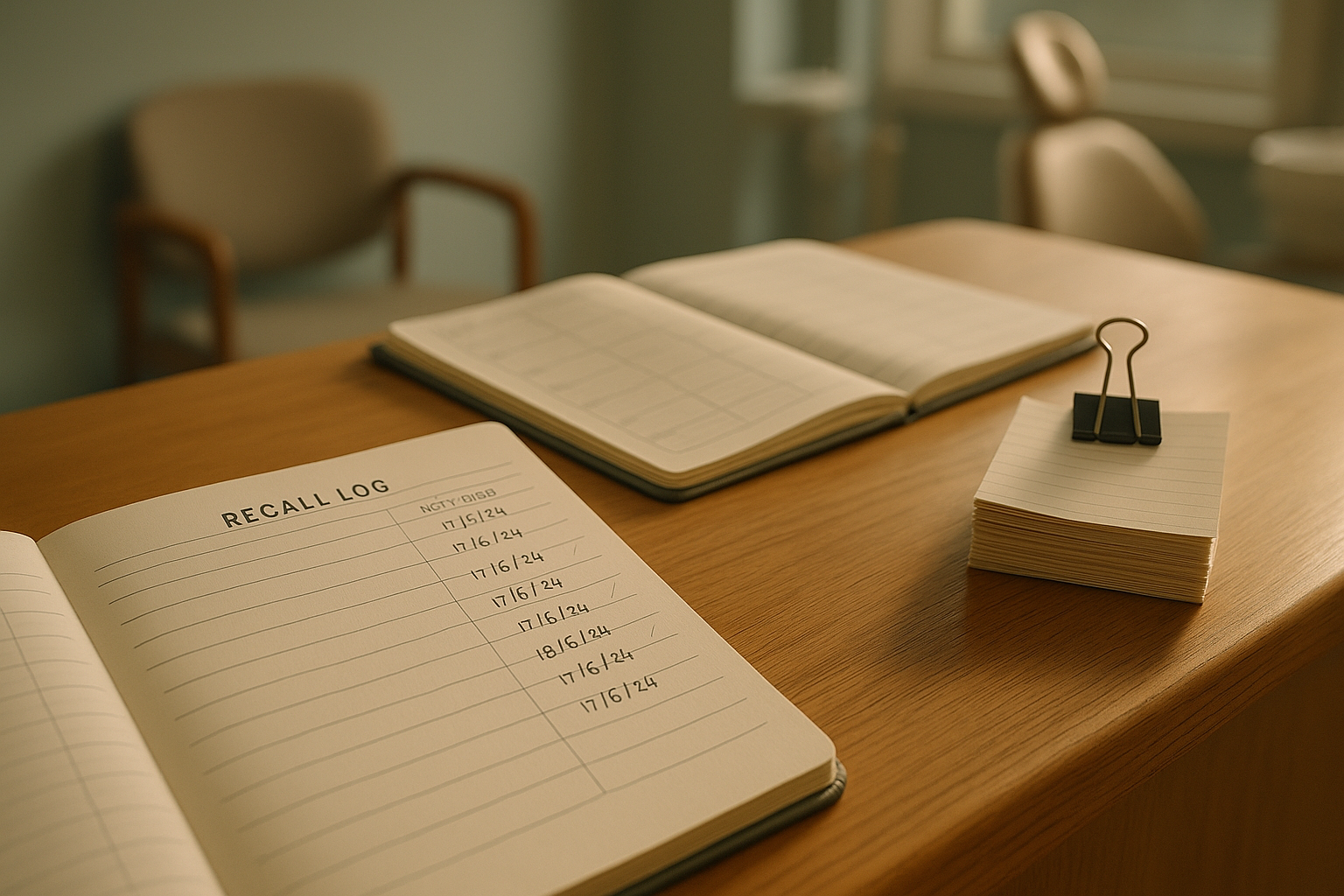
Ms Reyes came in for a cleaning in March. It is now September, and nobody has asked her to come back. Not because the clinic decided to let her go, but because nobody wrote down that she was due, and nobody looks for names that fall off the calendar. Multiply that by every patient the clinic saw between January and June, and the recall list becomes the largest source of appointments you never think about.
A recall system is what stops that from being a rounding error every month.
What a recall system actually is
Not a piece of software. A recall system is four things, in this order:
- A list of every patient with a next-due date. Not "everyone who has ever walked in". A patient with no scheduled next visit is not on the recall list. A patient with a next-due date but no active booking is.
- A state for each name. Due soon, due now, contacted, booked, parked, do not recall. Without states, a booked patient still gets recall texts and thinks the clinic is spamming her.
- A weekly workflow. Twenty minutes on a Monday morning where someone pulls the "due now" names, checks who is already booked, sends outreach to the rest, and marks replies.
- Three numbers you check every month. The reactivation rate, the time from due date to booked visit, and the do-not-recall rate. If the numbers move the wrong way, the system needs adjusting, not more messages.
A clinic that has all four has a system. A clinic that has software but not the four still doesn't.
The four questions to answer before you build anything
Who goes on the list?
Only patients whose next-due date is real. That means someone at the chair decided on the interval and wrote it down. A patient who came in once two years ago for a broken tooth and never scheduled a follow-up is not a recall candidate, that patient is a reactivation candidate, which is a different problem with a different message.
When are they due?
By treatment, not by default. A six-month interval is fine for most cleanings. It is wrong for a patient on periodontal maintenance, wrong for a patient whose retainer just came out, and wrong for a whitening touch-up. Interval by treatment is the section below.
Who owns it?
Ideally not the person answering Messenger and phones during clinic hours. Recall is proactive work; front desk work is reactive. Give recall to the same person if you must, but give it a fixed slot in the day where no walk-in and no phone counts. Fifteen minutes at 9:00 AM before the first patient arrives is usually enough for a small clinic.
How do you know it worked?
By the reactivation rate. Take the names that hit "due now" in July and count how many of them booked a visit within six weeks. That is your number. Anything else is a feeling.
Recall intervals by treatment
The default six months is not one number applied to everyone. The intervals that actually match the clinical reason for the recall look more like this. Confirm with the treating dentist for your own patients, this is a starting point.
| Treatment | Typical recall interval | Why |
|---|---|---|
| Oral prophylaxis (adult) | 6 months | Standard hygiene interval. Adjust down for high plaque or staining. |
| Periodontal maintenance | 3 to 4 months | Post scaling and root planing patients need tighter monitoring. |
| Fluoride treatment (paediatric) | 6 months | Combined with the cleaning visit for most kids. |
| Whitening touch-up | 12 months | Elective; too frequent starts feeling like an upsell. |
| Retainer check (first year) | 6 months | Fit and wear check while relapse risk is highest. |
| Retainer check (after year one) | 12 months | Annual is fine once wear is stable. |
| Root canal review | 6 months, then annually | Radiographic check on healing. |
| Implant maintenance | 6 to 12 months | Peri-implant tissue monitoring; the interval is the dentist's call. |
| Denture fit check | 6 to 12 months | Fit changes as the ridge remodels. |
| Braces adjustment | 4 to 6 weeks | Not a recall. This is a scheduled series and belongs in the appointment book with the visit already set. |
| Post-extraction check | 1 week | Not a recall either. This is follow-up, and should be booked before the patient leaves the chair. |
The last two rows are worth stating out loud, because clinics often bundle them into the recall list and end up with a queue full of visits that should never have been queued. If the next visit is close enough to book at the chair, book it. Recall is for the visits far enough away that a booking now would just be moved later anyway.
What to capture at the chair
The single hardest habit to build is capturing recall data while the patient is still in the room. If it moves to "the front desk will ask her when she checks out," most of it is lost. Six fields, all filled by the person doing the treatment:
- Next-due date. Specific, on a real calendar, not "in six months." Write "22 March 2027."
- Treatment code. So the interval and the messaging can be picked correctly later. Cleaning, perio maintenance, whitening, retainer, and so on.
- Preferred channel. SMS or Messenger. Ask, because assuming is how the wrong lane fills up.
- The number or handle to reach on that channel. Even if it is already in the record, confirm it. Numbers change.
- A short note if the patient's next visit needs anything unusual. "Wants Saturday only." "Bring recent X-ray."
- Any do-not-recall flag. Moved abroad, transferred to another dentist, deceased, or asked not to be contacted. This is a permanent flag, not a state.
A paper card at the chair works. A row in a shared spreadsheet works. A field in your clinic software works. What matters is that the capture happens in the room, on the day, by the person who knows the answer.
The states a recall passes through
Every name on the list is in exactly one of these six states at any moment. This is the piece that new clinics skip, and it is the piece that decides whether the system feels professional or spammy.
| State | Meaning | Moves to |
|---|---|---|
| Due soon | Within 30 days of the next-due date. Not yet contacted. | Due now, at the due date. |
| Due now | Inside the outreach window. First message goes out this week. | Contacted, or Booked if the patient replies immediately. |
| Contacted | First message sent, awaiting a reply. | Booked, or Parked after the second follow-up. |
| Booked | Visit is on the appointment book. All further recall messages muted. | Back to Due soon after the visit, at the new next-due date. |
| Parked | No reply after two attempts. Left alone for this cycle. | Due soon at the next cycle, so they get one more chance next time. |
| Do not recall | Permanent. Moved, deceased, transferred, or asked to stop. | Nowhere. |
The Booked state is the one that saves the clinic's reputation. When a patient replies to a recall text, books a slot the same day, and then still gets the next scheduled recall message on autopilot, she doesn't call and complain, she just doesn't come back. The whole point of the state field is to make sure that never happens.
The weekly workflow
A recall system that takes an hour a day dies inside a month. Aim for twenty minutes on a Monday morning, plus five minutes twice more in the week for replies.
Monday, 9:00 AM. Pull the list of names in "Due now" and "Due soon this week." Cross-check against the appointment book. Anyone already booked gets moved to Booked, no message. The rest get the first outreach in one batch. If your clinic uses SMS for recall, send them all at once; a fifteen-name batch takes three minutes with a working template.
Wednesday afternoon. Scan replies. Anyone who booked, move to Booked and mute. Anyone who replied but wants a different date, note it and reply back with two options. Anyone who has not replied, leave alone until Friday.
Friday, 9:00 AM. Second follow-up to any name still in Contacted from Monday. This is the last message that goes out for this cycle. If they don't reply this time, they move to Parked.
Twenty-five minutes, three touch points, one cycle per patient. That is the whole workflow.
Two sample messages a clinic could send under the SmileSkin sender ID, both a single SMS long.
First message, English, sent Monday:
Smile & Skin Clinic: Ms Reyes, your cleaning is due around 22 Mar. Book a slot: smileskin.ph/book. Message the Page for anything else. SmileSkin
Second message, Taglish, sent Friday if no reply:
Smile & Skin Clinic: Hi po Ms Reyes, gentle reminder about your cleaning na due this month. Book here po: smileskin.ph/book. Salamat, SmileSkin
Neither message asks the patient to reply. That is deliberate. The SMS lane most Philippine clinics use is send-only, so a "Reply YES to confirm" line looks like a reply option and quietly goes nowhere. The booking link does the confirming.
How you know it works
Three numbers, once a month.
Reactivation rate. Names that entered "Due now" in a given month, divided by names that ended up Booked within six weeks. A clinic starting from cold sees a lower number for the first few cycles, then it lifts as the list gets cleaner and the messages get sharper. Track your own number and its trend. Someone else's brochure figure is not a benchmark.
Time from due date to booked visit. If patients are booking three months after their due date, the outreach window is opening too late or the messages are landing on the wrong channel. Aim to have most bookings happen within two weeks of the due date.
Do-not-recall rate. If more than a few patients per month are asking to stop, the messages are too frequent, or the tone is off, or the same name is getting hit through more than one channel. Read the last three messages you sent to the last three complainers. The problem is usually visible in about ninety seconds.
If those three numbers stay flat for two months, the system is working and you can leave it alone.
Common mistakes
- Treating the whole patient database as the recall list. The list is patients with a real next-due date and no active booking. Everything else is either scheduled or lapsed. Lapsed patients are a separate outreach, with a different message.
- Sending the same message to every recall. A patient who was in three months ago for a filling gets a different opener than one who is due for her first cleaning of the year. Two templates is enough. Fifty is not.
- No stop rule. Two attempts per cycle. Then Parked. A clinic that keeps texting every three weeks until a booking happens gets blocked, which shows up in the do-not-recall rate a month later.
- Recall run by the phone-answering desk. Recall is proactive work and phone answering is reactive work. When they compete, recall loses every single time, because a ringing phone is louder than a spreadsheet.
- Software before system. A clinic that buys a recall tool before writing down its own intervals and states ends up shaped by the tool. Design the system on a whiteboard first. If your whiteboard version doesn't work on paper for a month, no software will fix it.
- Recall list frozen at the point of purchase. The list is a living thing. New patients get added at every treatment. Old patients move to Do not recall when they tell you. If nobody is maintaining the list, the numbers get quietly worse.
Where automation comes in
Once the system is real, one part of it becomes worth handing to software: sending the outreach message on the due date, through the channel the patient prefers, at a time of day the clinic picks. Everything else, the intervals, the states, and the notes only a person notices, is still human work.
OtterFlow handles that outreach piece for Philippine dental clinics. You set a next-due date at the chair, and the recall goes out on that date, over SMS or Messenger, in the language the patient uses. The clinic still owns the list, the intervals, and the notes. Setup: ₱0. Then 4,975 a month.
If your system already exists on paper and you just want to know how the automation piece slots in, the walkthrough is here: how to automate dental patient recalls.
The next step
Print a blank version of the six-field capture card and put it beside every chair on Monday. That is the whole first move. The intervals table can hang inside a treatment room. The state list can live on a whiteboard for the first month. Everything else follows once the capture habit is in.
The names to fill those quiet weekday afternoons are already on the books. A recall system is what makes sure they get asked.