
How to Send Payment Reminders for Dental Installment Plans Without Sounding Pushy
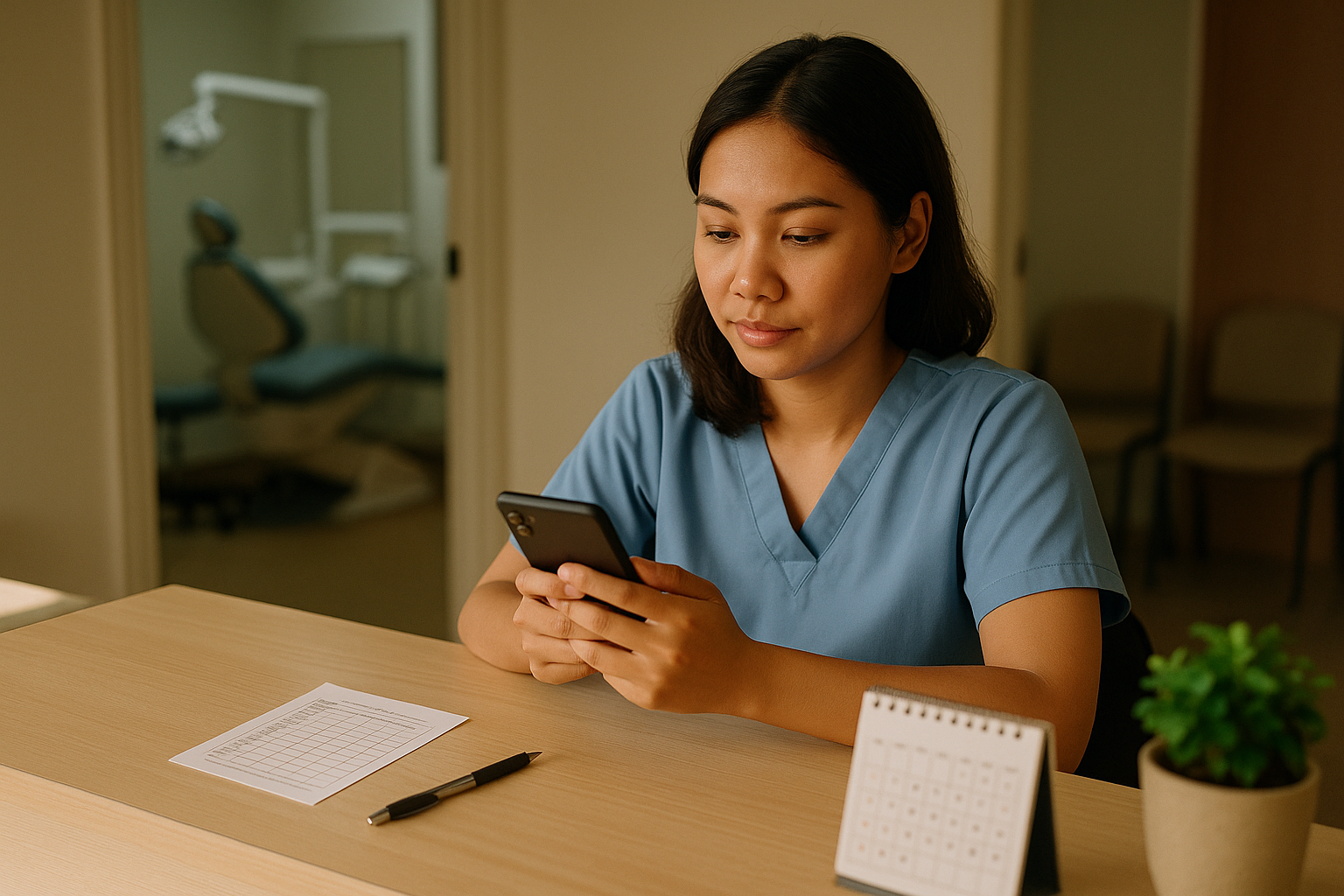
Mrs Dela Cruz took her dentures home in August. She's paying off the balance at ₱2,500 on the 15th of every month. It's now the 18th of October, and nothing has come in.
Jen has the clinic phone in her hand. She types "Good morning po, gentle reminder lang po sana...", deletes it, and tries something firmer. That one reads like a lending app. So she puts the phone down and decides to bring it up when Mrs Dela Cruz comes in next week for her denture check. At the counter, with four people in the waiting room.
That's the pushy version, and nobody chose it. It happened because nobody decided anything about reminders back in August.
Payment reminders come across as pushy when they surprise the patient, when other people can read them, or when they leave her no easy way to say "not this week". You settle all three on the day the plan starts, so most of this article is about that day, not the text.
Smile & Skin Clinic is the example clinic we use on this blog. The amounts are made up.
The short version
- Work out what kind of plan it is first. If the patient pays at each visit, as many braces plans do, don't send a payment reminder at all. The appointment reminder gets her in, and the payment happens at the desk.
- Agree on the reminder when the plan starts: which number, how many days before, and what it will say.
- Put each due date a day or two after the patient's payday. Ask when that is.
- Send one text before each due date. Put the date in it, and leave out the amount, the treatment, and anything that needs a reply.
- Once a payment is late, a person takes over, from a phone the patient can reply to.
- Never text about money after 9 PM, never message anyone except the agreed payer, and never introduce a fee in a reminder.
Why reminders come out pushy, and why skipping them is worse
Most clinics don't send too many payment reminders. They send none, and then the balance comes up at the worst moment: at the counter, in a call during the patient's workday, or in a text from someone who's annoyed it got this far.
Saying nothing costs you something else, too. A patient who's short this month rarely calls to say so. It's hiya, mostly. She stays home rather than walk in owing money, misses her next visit, and the gap gets harder to close every month. We've seen the same thing with braces patients who drift away one skipped adjustment at a time.
So a reminder has two jobs. Getting the payment in is one. The other is keeping her talking to you in the month she can't pay, because a patient who asks "pwede po next week?" is one you can work with. A patient who goes quiet isn't.
Three kinds of plan, three different reminders
| How the plan is paid | Where you usually see it | What to send |
|---|---|---|
| At each visit: a downpayment, then a fixed amount at every appointment | Braces, paid at the monthly adjustment | No payment reminder. The appointment reminder is enough |
| On a calendar date: the same amount on the same day each month, visit or no visit | A balance split into months after the work is done, like dentures | One text, three days before each due date |
| By stage: a payment before each stage of treatment starts | Staged work, like implants or dentures with lab steps | A call or a personal message about a week before the stage |
When the adjustment is the payment, a separate payment reminder tells the patient that coming in costs money this month. Some will stay home to avoid that conversation. Send the normal appointment reminder, keep the balance out of it, and talk about money at the desk. We said it in the braces article, and it holds here. A patient who walks in owing a month is better than one who stays home owing a month.
A plan due on a calendar date is the one that needs a reminder, because nothing else tells her the date is coming. Most of what follows is about this kind.
Stage payments are bigger, and if your clinic takes them before ordering lab work, the timing matters to you as much as to her. Have a person handle those, not an automated text. Jen calls a week ahead, confirms the stage appointment, and mentions the payment that comes before it.
If the patient is paying through a credit card installment or a financing company, the clinic has usually been paid already, and the bank or the financing company sends the reminders. This article is about plans your clinic runs itself.
Settle the reminders on the day the plan starts
A reminder the patient agreed to in August isn't pushy in October. It's the clinic doing what it said it would.
Put the schedule in writing
The patient takes home a payment schedule, and a copy goes in her record. It needs:
- the total, the downpayment and the balance
- each due date and amount, written as dates (Sep 15, Oct 15, Nov 15) rather than "monthly"
- how to pay: the clinic's one GCash number and the account name, or cash at the desk
- who's paying, and their mobile number
- what happens when a payment is late, in the dentist's words
Our guide to taking GCash deposits and downpayments over Messenger covers the downpayment message and why you check the wallet, not the screenshot.
The last line on that list is the one clinics skip. Have the dentist decide it once: how many days' grace, what Jen can offer without asking (a later due date, splitting a month in two), and whether there's any fee. If there's a fee, it goes on the schedule from day one. A fee that first shows up in a reminder is the pushiest text a clinic can send.
Put the due date after payday
Ask her: "Kailan po kayo madalas sumasahod?"
The Labor Code makes employers pay wages at least twice a month, no more than 16 days apart (Article 103), and plenty of them pay on the 15th and at the end of the month. A patient paid on the 15th with a due date on the 13th gets your reminder in the week she has the least money, every month. She learns to dread your sender name. Move the due date to the 16th or 17th and the same text arrives when she can do something about it.
Not everyone is on a payroll. If she runs a small business or the family waits on a remittance from abroad, ask when money usually comes in, and use that.
Agree on the reminder itself
Tell her exactly what's coming, in the same conversation:
Para hindi po kayo mabigla, magte-text po kami 3 days before ng bawat due date. Date lang po ang nakalagay, walang amount. Okay lang po ba sa number na ito? Kayo lang po ba ang gumagamit ng phone na ito?
In English:
So it doesn't catch you off guard, we'll text you three days before each due date. It'll have the date, not the amount. Is this number okay? Are you the only one who uses this phone?
The phone question matters. Plenty of households share a phone, and the number on a teenager's record may be her mother's. If a parent is paying, the reminder goes to the parent. If someone else in the family handles the money, put their number on the plan, with the patient's say-so.
Write her answers in the record. If she asks months later why the clinic texted her, you can point to the day she said yes.
What the reminder should say
Smile & Skin Clinic: Hi Mrs Dela Cruz, your next scheduled payment is due on Oct 15. If you've already paid, thank you! Questions? Call 0917 XXX XXXX.
That's 150 characters. In Taglish, at 158:
Smile & Skin Clinic: Hi Mrs Dela Cruz, paalala lang po na sa Oct 15 ang next payment ninyo. Kung bayad na po kayo, salamat po! Tawag lang po sa 0917 XXX XXXX.
What each part is doing:
- The clinic's name comes first. The text arrives from a short sender name like SmileSkin, so she should know who's writing before she reads anything about money.
- The date goes in, the amount stays out. She has the amount on her schedule. On a lock screen, "payment due Oct 15" tells whoever picks up her phone very little. "₱2,500 balance for your dentures" tells them a lot, and details of her treatment are sensitive personal information under the Data Privacy Act. What the Data Privacy Act means for clinic texts has the lock-screen test in full.
- "If you've already paid, thank you" is for the patient who paid on the 10th. Without it, she gets a reminder anyway and feels chased. With it, the same text reads as a thank-you. It matters most when the reminder is automated, because whatever sends it doesn't know she paid.
- It gives a number to call instead of asking for a reply. Texts from a sender name like SmileSkin are send-only. "Reply PAID" goes nowhere, and she'll think you ignored her.
Leaving the amount out helps the character budget too. The ₱ sign isn't in the standard SMS character set, so a single ₱ switches the whole text to an encoding that fits 70 characters per segment instead of 160. A long patient name can still push either sample over, so leave some room. Our reminder SMS templates go through the budget in detail.
What pushy looks like, and what to write instead
| What clinics send | Why it lands badly | Write this instead |
|---|---|---|
| "FINAL REMINDER: Your balance of ₱5,000 is OVERDUE." | Capitals read as shouting, and the amount and "overdue" are now on her lock screen | The date, in normal case |
| "Kindly settle your outstanding balance immediately to avoid inconvenience." | "Inconvenience" is a threat that won't say what it is | When it's due, and who to call for more time |
| "Reply PAID once settled." | Nothing comes back from a sender name | A number to call |
| "Hi po, gentle reminder lang po sana if okay lang po..." | So soft it reads as optional, and she'll treat it that way | One plain sentence with the date |
| Three texts in the week before the due date | One reminder is information. Three is pressure | One text, three days before |
When to send, and when a person takes over
For a plan due on the 15th:
| When | Who | How | What |
|---|---|---|---|
| The 12th, mid-morning | Your reminder system, or whoever sends reminders | SMS from the clinic's sender name | The reminder above |
| The 15th | Nobody | Nothing. One reminder was enough | |
| The 18th | Jen | A text from the clinic's own phone | A personal check-in she can reply to |
| Around the 25th | Whoever set up the plan | A phone call | Options the dentist already approved |
| The next visit | The dentist, if it's still open | In person, in private | Whatever the written policy says |
Three days before is our recommendation, not a number anyone has measured. It leaves time to move money through GCash or wait for payday, and it's close enough that she won't forget again. Send in the morning, and never after 9 PM. The NTC bars broadcast texts between 9 PM and 7 AM, and a text about money at night lands worse than any other. The best time to send recall messages covers that rule.
The first late message comes from a person
Before the due date, an automated text is fine, because it says the same thing to everyone. After the due date, every case is different. She forgot. The GCash went to an old number. Her husband's sahod came in late. Or she's in trouble and embarrassed to say so. A text can't tell those apart, and an automated "your payment is overdue" treats all four like the last one.
So on the 18th, Jen texts from the clinic phone, where Mrs Dela Cruz can reply:
Hi Mrs Dela Cruz, si Jen po ito ng Smile & Skin Clinic. Hindi pa po namin nakikita ang Oct 15 payment, baka na-miss lang po. Kung mas okay ang ibang date, sabihan lang po ako.
In English:
Hi Mrs Dela Cruz, it's Jen from Smile & Skin Clinic. We haven't seen the Oct 15 payment yet. Maybe it slipped by. If another date works better, just tell me.
"Hindi pa po namin nakikita" says the clinic hasn't found the payment. It doesn't say she hasn't paid. If it went to the wrong GCash number, she can say so without feeling accused. And the offer of another date is in the first message, so she doesn't have to work up the nerve to ask.
Then a phone call
If a week passes with nothing, someone calls. Ideally it's whoever sat with her when the plan started. Have the options ready before dialling, approved by the dentist in advance, so nobody improvises a deal mid-call:
- move this month's due date to after her next payday
- split this month into two smaller payments
- add the missed month to the end of the plan
Ask what happened before offering anything, then let her choose. Write down what you agreed and text it to her from the clinic phone the same day, so you both have the same version.
After that, it's the dentist's call
Whether treatment carries on while a balance is open is the dentist's decision. The dentist should make it once, in the written policy, not patient by patient at the counter. For braces, we'd keep her coming. You still have the money conversation, and the treatment stays on track while you have it.
Where the line is
We couldn't find a Philippine rule written for clinics collecting from their own patients. The closest is the SEC's Memorandum Circular No. 18, series of 2019, which covers lending and financing companies. Its list of unfair collection practices includes contacting a borrower before 6 AM or after 10 PM, contacting people in the borrower's contact list other than named guarantors or co-makers, publishing the names of people who allegedly won't pay, threatening action that can't legally be taken, and using insults (summary by P&A Grant Thornton).
The circular is written for lenders, not clinics. It's still a fair list of what a patient will experience as harassment, and each item has a clinic version:
- Texting her sister because she's the emergency contact. That number is for emergencies.
- A post on the clinic's Page about "patients who don't settle their balance", even with no names. Everyone who owes you will read it as being about them.
- "We will be forced to take legal action" in a text about ₱2,500.
- Asking about the balance in the waiting room, where other patients can hear.
- Any message after 9 PM.
Common mistakes
- Sending a payment reminder to a braces patient who pays at each adjustment. It turns the appointment into a bill.
- Putting the amount and the treatment in the text. The lock screen isn't hers alone.
- Texting the patient when someone else pays. The reminder goes to whoever decides.
- Leaving out "if you've already paid", so the patient who paid early feels chased.
- Automating the overdue message. A late payment needs someone who can say yes to a new date.
- Letting whoever's on the desk invent terms. "Sige po, next month na lang" becomes the deal, whether or not the dentist would have agreed to it.
- Introducing a late fee in a reminder. If it wasn't on the schedule in August, it doesn't exist in October.
Where OtterFlow fits
OtterFlow doesn't take payments, doesn't keep balances, and can't tell who has paid. The schedule, the payment log and the late-payment conversation stay with your team, and everything above works the same whether you use us or not.
Two parts of OtterFlow come into this.
The first is the question that comes before any plan exists. A patient messages your Page at 10 PM: "pwede po ba hulugan?" Flo, OtterFlow's AI front desk, answers from the installment terms you approved, in English, Taglish or Bisaya to match how she wrote. She gets the same downpayment and the same rules every time, not whatever version the person on the inbox remembers. Then Flo offers consultation times that are genuinely open and books one. If she later asks "magkano pa po balance ko?", Flo doesn't know, so it says so and flags the conversation for your team. Jen can take it over from there. If you'd like to see that, our Messenger chatbot page has a live Flo you can talk to.
The second is the monthly text for a calendar-date plan. OtterFlow's SMS reminders page sends a recurring text to one person on a rhythm you set, so a plan due on the 15th is a single reminder:
| Field | Set it to |
|---|---|
| Repeats every | 1 month |
| Starting on | The 12th of the month the first payment is due |
| Send at | 10:00 |
| Stop after | The 12th of the month the last payment is due |
| Booking link | No booking link |
And the message:
{tenant_name}: Hi {name}, paalala lang po na sa 15th ang next payment ninyo. Kung bayad na po kayo, salamat po! Tawag lang po sa 0917 XXX XXXX.
There are two things it can't do, and that setup works around both. It doesn't know when someone pays, which is why the thank-you line is there and why you pause the reminder when a patient finishes the plan early. And the {date} placeholder fills in the day the text goes out, the 12th, not the due date, so type the due day into the message yourself. The full walkthrough is in recurring patient SMS reminders.
For braces paid at each adjustment, you don't need any of this. The appointment reminders, a day before and an hour ahead, get her in the door, and they never mention money.
Setup: ₱0. Then 4,975 a month, which includes the SMS allowance these reminders draw from.
Before the next 15th
Pull out every installment plan running right now and check three things on each one. Does the patient have the schedule in writing? Is the reminder going to the person who actually pays? Does the due date fall after their payday? Fix the ones that fail before the next due date. Start with whoever's already behind, and call them rather than text.
And if the "pwede po ba hulugan?" messages are piling up in the inbox overnight, book a 15-minute call and we'll show you how Flo would answer them with your clinic's terms.