
How to Book OFW and Balikbayan Dental Patients Before They Fly Back Abroad
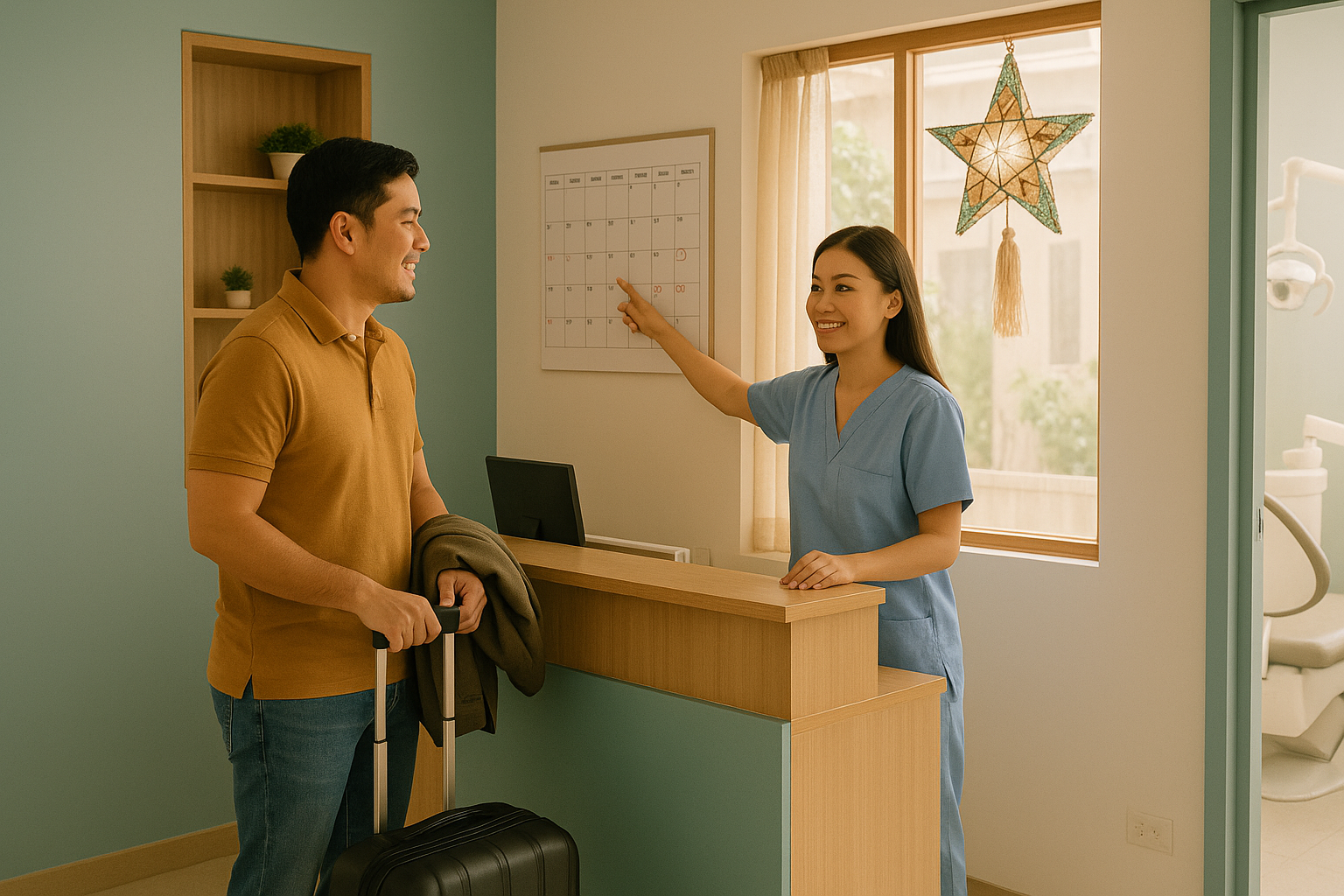
At 3:12 on a Monday morning in November, a message lands in Smile & Skin Clinic's Messenger inbox. It's 11:12 PM in Dubai, and Mr Cruz has just finished his shift.
"Hi po, magkano po pa-crown? Uuwi po ako this December."
Jen sees it at 8:30 and sends the price. A few hours later he writes back: "Sige po, pag-uwi ko na lang po magpa-schedule."
He lands on 19 December and messages again on the 21st. The first open slot is the 23rd, the clinic's last day before the Christmas break. The dentist prepares the tooth and sends the impression to the lab, which closes the next day as well and needs five working days once it reopens. Mr Cruz flies back to Dubai on 6 January with a temporary crown. The permanent one is ready two days later, and it goes in a drawer to wait for next December.
Nobody in that story did a bad job. Jen replied the same morning, the dentist did good work, and the lab was on time by its own calendar. The trip was lost back in November, because nobody asked Mr Cruz when he was flying back.
The short version
- In your first reply, ask for two dates: when they land and when they fly back. Write the flight date on the booking.
- Book the first visit before they land, for their second or third day home.
- Plan the treatment backward from the flight, not forward from the first visit.
- Book every visit in the plan at the first appointment, before they leave the chair.
- Put a Philippine number on the booking so the reminders arrive.
- Before they fly, tell them what's done and what's left, ask when they're home next, and set their recall for that trip.
Why these patients need their own process
Most patients can come back next week. An OFW can't, because their deadline is a plane ticket.
There are a lot of them. The Philippine Statistics Authority estimated 2.19 million overseas Filipino workers in 2024, with the biggest groups in Saudi Arabia (21.9 percent) and the UAE (12.4 percent), according to SunStar. The law's idea of a balikbayan is wider than OFWs, too. Republic Act 9174 also covers any Filipino citizen who has been out of the country continuously for at least a year, and former Filipinos naturalised abroad, along with their families. The nurse home from London, the seafarer between contracts and the retired couple visiting from California all end up on the same list.
Four things make them different from a patient who lives down the road:
- The deadline is theirs, and it doesn't move. Changing a flight costs money, and a worker's leave ends when the employer says it does.
- They plan from abroad, on another clock. Riyadh is five hours behind Cebu and Dubai is four. A message sent after a shift arrives in the small hours, and your 9 AM reply reaches them at 4 or 5 in the morning.
- They come home when everyone does. NAIA handled about 61,000 arrivals a day over the 2025 holidays, which the Bureau of Immigration put down mainly to overseas Filipinos coming home (DZRH). That's the same stretch when your clinic closes for the break and your book is already full.
- They're often booking for the whole family. Mama's dentures, the kids' cleaning, a sister's filling, all paid for by the one person who's only home for three weeks.
Step 1: Ask for two dates in your first reply
The usual question is "Kailan niyo po gusto?" The useful one is when they arrive and when they leave. Everything else in this guide counts back from the second date.
You still answer the price (the price reply guide covers how), but put the dates question in the same message. In Taglish:
Hi po Mr Cruz! 2 visits po ang crown, mga isang linggo ang pagitan kasi sa lab po ginagawa. Kailan po kayo darating, at kailan po ang flight niyo pabalik? Para ma-book na po natin ngayon ang first visit niyo bago mapuno ang December.
Or in English:
Hi Mr Cruz! A crown takes two visits about a week apart, because the lab makes it. When do you land, and when do you fly back? If we book your first visit now, we can fit both in before your flight.
Some patients haven't bought the ticket yet. Tell them your closure dates in the same reply, while they can still pick a flight that leaves time for the lab.
Once you have the flight date, put it where everyone will see it: the booking notes, the patient record, the top of the chart. "FLIES 6 JAN" on a booking does more work than anything else in this article.
"Pag-uwi ko na lang po" isn't a booking
It sounds like a yes. What it means is that nothing happens until they land, and in December that's too late. Answer it with a slot:
Sige po! Pero mabilis po mapuno ang December. Pwede po namin kayong i-hold ng 9 AM slot sa Monday, Dec 21, para sure na po. Okay po ba?
Book it while the conversation is still open. A Facebook Page can only message someone freely for 24 hours after their last message, so once Mr Cruz goes quiet you can't chase him over Messenger in December. The guide to SMS, Messenger and Viber reminders explains the rule.
If you hold December slots weeks ahead, a reservation fee is reasonable. Settle the amount, the deadline and the refund rule before you ask, and confirm the slot only when the money shows in the clinic's account, never on a screenshot. The GCash deposits guide has the workflow.
Step 2: Book the first visit before they land
The first visit is where the dentist finds out what the trip actually holds. A patient who wants "crown lang po" might need a filling on the next tooth or a root canal under the crown. Each finding needs days, and those days come out of what's left of the trip.
So book the first visit early, on the second or third day home. Not the day they land, after an overnight flight and an airport full of relatives. And not "sometime in the first week", because that's how the first week turns into the second.
Before they arrive, the front desk can send what's on your price list: the price range and how many visits a treatment usually takes. Don't let anyone plan treatment from a photo in the chat. That's the dentist's job, at the chair, once the patient is home.
Step 3: Plan backward from the flight
A normal treatment plan runs forward: first visit, then the next one when it suits. An OFW's plan has to run backward from the flight, so the dentist needs the flight date before writing it. Three things eat into the days in between.
The gaps between visits
| Treatment | Visits | What sets the timeline | When to book it |
|---|---|---|---|
| Cleaning or filling | Usually one | Nothing much | Anywhere in the trip |
| Simple extraction | One | Healing before the flight | Early enough to heal before flying. A week ahead is better |
| Root canal | One or more, depending on the tooth | The tooth, and often a crown afterwards | In the first few days, so a crown can follow |
| Crown or bridge | Two, with lab days in between | Your lab's turnaround | Prep in the first days, and fit it with a day to spare |
| Dentures | Several fittings | Fittings and adjustments | From the first visit day, or split across two trips |
| Implant | Two stages, months apart | Bone healing, three to nine months | Implant this trip and crown on a later one, if the dentist agrees |
A Cochrane review found that root canal treatment can be done in one appointment or several, with no evidence that either is more effective (Cochrane). The dentist decides which, tooth by tooth. Cleveland Clinic puts the time for the jawbone to fuse with an implant at three to nine months.
Some plans won't fit in one trip. Say so at the first visit and split the plan into what gets done now and what waits for the next homecoming, rather than squeezing the last step into the day before the flight.
The lab's calendar
Your lab takes a Christmas break too, and its dates may not match yours. Ask in November when it closes, when it reopens, how many working days a crown takes in December, and whether it'll rush a case that arrives in the last days before the break. Write the answers next to your own holiday closure dates.
Healing before the flight
Cabin pressure changes during a flight. A fresh extraction site can bleed and a tooth mid-treatment can hurt at altitude. A 2023 review in the British Dental Journal by Felkai and colleagues lists these as the earliest times to fly, as long as there's no pain, swelling or bleeding (full text):
| Procedure | Earliest time to fly |
|---|---|
| Filling or other restorative work | 24 hours |
| Simple extraction | 24 to 48 hours |
| Surgical extraction, such as a wisdom tooth | 72 hours |
| Root canal treatment (non-surgical) | 72 hours |
| Implant placement, uncomplicated | 72 hours |
| Sinus lift or bone graft | At least two weeks |
The same review recommends waiting a week after most dental work, and says patients shouldn't fly home immediately after a procedure. Those are minimums from a literature review, not a rule for your patient, and the dentist makes the call. The front desk's part is simpler: don't book an extraction for the day before a flight just because it was the only open slot.
Mr Cruz's December, planned from November
Here's the trip from the opening, if Jen had asked for his dates in November and booked him then. He lands on Saturday 19 December and flies on Wednesday 6 January. The clinic closes from 24 December to 3 January, and so does the lab. In November, Jen asked the lab whether a crown that reached it by Monday noon could be back by Wednesday, and it said yes.
| Date | What happens |
|---|---|
| Sat 19 Dec | Mr Cruz lands |
| Mon 21 Dec, 9 AM | Exam, cleaning and crown prep. The impression reaches the lab by noon |
| Wed 23 Dec | Crown fitted, on the clinic's last day before the break |
| Thu 24 Dec to Sun 3 Jan | Clinic and lab closed |
| Mon 4 Jan | A slot held in case the crown needs adjusting |
| Wed 6 Jan | Mr Cruz flies back |
Count the days. He's in the country for 19 of them, and only five are days the clinic is open and he isn't at the airport. If the exam on the 21st turns up a root canal, the plan changes that morning, and the 21st is the earliest anyone could have known. That's why the first visit has to be booked from abroad.
Step 4: Book the whole plan before they leave the chair
"Balik na lang po kayo next week" works for a patient who lives in Mandaue. For an OFW it means next week's slots go to someone else, because in December next week is already full.
Before the patient stands up, every visit in the plan should have a date and a time, and the last one should leave a day to spare before the flight.
Keep some room in the book for this. From late November to early January, leave one slot a day free for patients partway through a plan. If nobody has claimed it by the afternoon before, give it to your waiting list.
Step 5: Get a number that works in the Philippines
Before they arrive, an OFW is on a foreign SIM and Messenger. Clinic reminders usually go out through a Philippine SMS gateway, and those are built for local numbers. Semaphore's API documentation, for one, describes sending "to Philippine numbers". A reminder addressed to a +971 number may simply never arrive.
So ask: "Anong number po ang gagamitin niyo pag nandito na kayo?" Put that Philippine number on the booking. It can be their own local SIM, or a family member's if the patient agrees.
The SMS confirmation sent in November may then sit on a Philippine SIM in a drawer until they land. That's fine, because the booking was confirmed in the chat at the time. The texts that count are the reminders, the day before and on the day, and by then they're home with the local SIM back in the phone.
A reminder for the day before, at 130 characters:
Smile & Skin Clinic: Welcome home, Mr Cruz! See you tomorrow, Mon 21 Dec, 9 AM. Need to move it? https://yourclinic.ph/manage/8KD2
In Taglish, at 134:
Smile & Skin Clinic: Welcome home po, Mr Cruz! Kita po tayo bukas, Mon 21 Dec, 9 AM. Need i-resched? https://yourclinic.ph/manage/8KD2
Neither asks the patient to reply, because a text from a sender name like SmileSkin can't receive one. The link does that job. Keep it a full web address rather than a shortened one, which carriers tend to drop, and register the sender name, or the text may not arrive at all. The counted SMS templates explain the 160-character limit.
Step 6: Book the family as one block
The OFW home for three weeks is often the one paying for everyone's teeth. If Mama needs dentures and the kids need a cleaning, book them back to back on one morning, so a single trip to the clinic covers everyone.
Each person still gets their own booking and their own record, under their own name. One booking under the OFW's name means the next dentist reads the wrong history.
Give each patient their own contact number, too. Mama's denture adjustments carry on after her son flies back. If her bookings carry his number, the reminders for her follow-ups go to a SIM that has left the country with him.
Health information counts as sensitive personal information under the Data Privacy Act, and that doesn't change inside a family. The son can book for his mother. Whether he's the one told what the dentist found is her decision, not his. The Data Privacy Act guide covers what that means for your inbox.
Step 7: Use the last visit to set up the next trip
The last appointment before the flight has three jobs.
- Check the timing. If the last procedure is too close to the flight for the dentist's comfort, the dentist says so before starting, not after.
- Write down what was done. A short note listing the treatment, the teeth and what's still planned. If a crown comes loose in Dubai, the dentist there will want it. Send a copy on Messenger so it's on their phone.
- Ask when they're home next. "Kailan po ang next uwi niyo?" Write the answer on their record.
Step 8: Set the recall for their next trip home
A six-month recall assumes the patient can come in six months from now. An OFW who comes home once a year can't. Their recall date is their next homecoming, and the reminder has to reach them early enough to book before they land. Six weeks before the trip they mentioned is a good default.
That text has the same number problem as before. If they keep their Philippine SIM on roaming, use it. If not, ask at the last visit whether they'd like it sent to a family member, or ask them to message the Page as soon as they've booked the flight. The recall system guide covers the rest of the setup.
At 134 characters:
Smile & Skin Clinic: Hi Mr Cruz, home again this December? Book your check-up before the holiday rush: https://yourclinic.ph/book/7QX2
In Taglish, at 141:
Smile & Skin Clinic: Hi Mr Cruz! Uuwi po ba kayo this December? Book na po ng check-up bago mapuno ang slots: https://yourclinic.ph/book/7QX2
Common mistakes
- Answering the price and never asking for the dates.
- Taking "pag-uwi ko na lang" as a booking.
- Booking the first visit in their second week home.
- Planning forward from the first visit, so the last step lands after the flight.
- Forgetting that the lab closes for Christmas too.
- Booking an extraction or a root canal the day before the flight because it was the only slot left.
- Sending reminders to a foreign number, or to the OFW's number for a parent who's staying behind.
- Putting a once-a-year patient on a six-month recall.
Where OtterFlow fits
Software can't write the treatment plan or call your lab. What it can do is answer the 3:12 AM message, which is where this whole article starts.
In a clinic running OtterFlow, Mr Cruz's November goes differently:
- His message arrives at 3:12 AM. Flo, the AI front desk, answers in seconds, in the Taglish he wrote in, from what the clinic approved: the crown price, how many visits it takes and the Christmas closure dates the owner put in the knowledge base.
- He asks for the 21st. Flo offers only times that are genuinely open that day, and books the one he picks.
- The booking carries the mobile number he gives, so the SMS confirmation and the reminders go there, each with a Manage link in case his plans change.
- If he asks something clinical, like whether he can fly the day after an extraction, Flo doesn't guess. It flags the conversation, and Jen or the dentist can take it over.
It won't ask the lab for a rush, plan the visits around his flight, or decide how soon he can fly. That's still the dentist and Jen, working from the flight date on the booking. If the overnight inbox is where these patients slip away, see how OtterFlow handles booking.
Before December
Go through last December's book this week and mark every patient who was home from abroad. Some of them will be home again this year, and nobody has asked them for a flight date yet. Then ask your lab for its Christmas schedule. If you'd like to see what Flo would have said to Mr Cruz at 3:12 AM, book a 15-minute call and we'll run it against your own December.